

Advanced Base Camp is an important term in mountaineering that describes a high-altitude staging camp used to support climbers as they move toward more difficult sections of a mountain. It is not a universal camp at one fixed altitude because its location depends on the mountain, climbing route, expedition strategy, and terrain.
On Mount Everest, the term Advanced Base Camp is particularly associated with the northern route in Tibet, where the camp is established on the East Rongbuk Glacier below the North Col. Historical expedition records and modern route descriptions place the Everest North-side ABC at roughly 6,400–6,500 metres (about 21,000–21,300 feet), although reported elevations vary slightly according to the exact camp location.
What Is an Advanced Base Camp?
An Advanced Base Camp is essentially a forward operating position for a mountaineering expedition. It is established higher on the mountain than the primary Base Camp and allows climbers and support teams to work closer to the upper climbing route.
The purpose is not simply to provide somewhere to sleep. An Advanced Base Camp can function as a place for acclimatization, equipment storage, food preparation, route planning, weather monitoring, and preparation for movement toward higher camps.
The exact arrangement differs from expedition to expedition. Some ABCs may have several tents and extensive supplies, while others may be relatively basic. Historical records from Everest expeditions show that teams have established Advance Base at different elevations depending on their route and objectives.
Advanced Base Camp on Mount Everest
Mount Everest has two principal climbing sides: the southern route through Nepal and the northern route through Tibet. The terminology used for camps differs between these routes.
On the north side of Everest, the Advanced Base Camp is a clearly established part of the traditional route toward the North Col. PBS’s detailed description of the northern climbing route places ABC at approximately 21,300 feet (about 6,500 metres) on the lateral moraine of the East Rongbuk Glacier. From there, climbers continue toward the North Col.
Modern expedition descriptions similarly place the North-side Advanced Base Camp at approximately 6,400–6,500 metres. This makes it an extremely high camp, where environmental conditions are considerably more demanding than at ordinary trekking elevations.
Where Is Everest Advanced Base Camp?
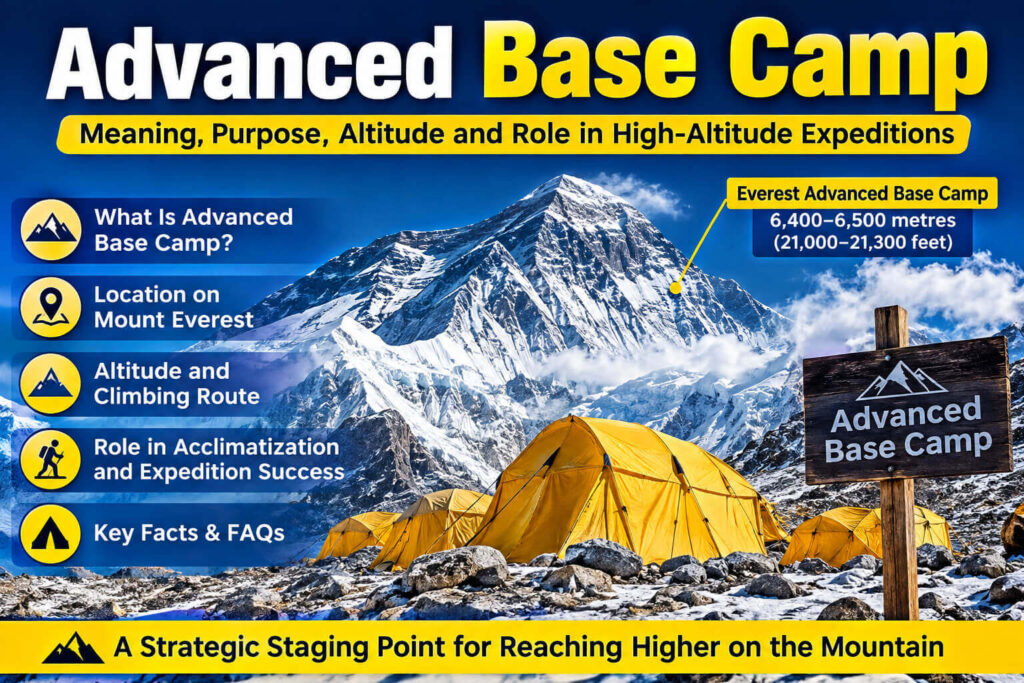
Everest’s northern Advanced Base Camp is located in Tibet along the East Rongbuk Glacier, beneath the North Col. The surrounding landscape is dominated by glaciers, rock, ice, and the immense upper slopes of Everest.
The camp’s position is strategically useful because it reduces the distance climbers must travel to reach the North Col and the higher sections of the mountain.
A historical American Alpine Club account records an Advance Base established at approximately 21,000 feet after the expedition moved equipment from its lower Base Camp along the Rongbuk Glacier.
Kitchen Upgrading Tips Mintpalment
Why Is Advanced Base Camp Important?
The biggest advantage of an Advanced Base Camp is its strategic position.
High-altitude climbing requires careful management of energy, equipment, food, oxygen, shelter, and acclimatization. A camp farther up the mountain gives an expedition a practical location from which climbers can make progress toward higher terrain without carrying everything directly from the main Base Camp.
It can also serve as a recovery point during acclimatization rotations. Climbers may move upward, spend time at elevation according to their expedition plan, and then descend to lower elevations to recover.
This process matters because the human body has difficulty adapting to very high altitude. The UIAA notes that Everest expeditions require acclimatization before climbers attempt progressively higher camps.
Advanced Base Camp and the North Col
On Everest’s northern route, the North Col is the major climbing feature immediately above the Advanced Base Camp.
From ABC, climbers travel toward the head of the East Rongbuk Glacier and then climb toward the North Col. Historical route descriptions place the North Col at approximately 7,000 metres, making the climb from ABC another significant gain in elevation. NASA describes the northern approach as leading through the East Rongbuk Glacier toward the North Col and then to progressively higher camps on Everest’s North Face.
Therefore, ABC is not the summit and is not the final high camp. It is a strategic stepping stone within a much longer and more demanding climbing system.
Is Advanced Base Camp the Same as Everest Base Camp?
No. Advanced Base Camp and Base Camp are not necessarily the same thing.
Base Camp normally serves as the primary operational starting point for an expedition. An Advanced Base Camp is positioned farther up the mountain when the route and expedition strategy require an additional forward camp.
On Everest’s northern route, for example, the main Base Camp is located much lower than ABC. Historical and modern expedition descriptions show Base Camp around 5,150–5,200 metres, while ABC is around 6,400–6,500 metres.
There is also an important terminology difference on Everest’s southern route. The British Mountaineering Council explains that Camp 2, in the Western Cwm, is sometimes called an “advanced base,” but it is generally referred to as Camp 2.
This distinction is important because saying that every Everest route has an identical ABC would be inaccurate.
What Conditions Can Climbers Expect?
Conditions at an Advanced Base Camp are severe. At approximately 6,500 metres, the air contains substantially less available oxygen than at sea level. Cold temperatures, strong winds, snow, ice, rocky terrain, and rapidly changing weather can make even simple activities difficult.
Moving around at this elevation requires significant physical effort. Climbers must also manage hydration, nutrition, rest, clothing, equipment, and acclimatization carefully.
ABC is therefore a mountaineering environment rather than an ordinary tourist campsite. Reaching it requires appropriate preparation, experienced support, permits where applicable, and a suitable expedition plan.
How Does an Advanced Base Camp Support Acclimatization?
Acclimatization is one of the most important reasons high-altitude expeditions use progressively higher camps.
Instead of immediately attempting the summit from a lower elevation, climbers gradually expose their bodies to higher altitudes. The expedition’s exact acclimatization schedule depends on the mountain, weather, climber, route, and professional team’s strategy.
An Advanced Base Camp can become part of this progression by providing a higher location from which climbers can make controlled movements toward the upper mountain.
However, simply reaching ABC does not mean that someone is automatically acclimatized. Altitude illness remains a serious risk at these elevations.
Frequently Asked Questions About Advanced Base Camp
What does Advanced Base Camp mean?
Advanced Base Camp means a higher expedition camp established above a main Base Camp to support climbing operations farther up a mountain.
How high is Everest Advanced Base Camp?
On Everest’s northern route, ABC is generally described at approximately 6,400–6,500 metres, or around 21,000–21,300 feet, depending on the source and precise camp location.
Is Advanced Base Camp higher than Everest Base Camp?
Yes, on the northern Everest route, ABC is significantly higher than the main Base Camp. The North-side Base Camp is around 5,150–5,200 metres, while ABC is around 6,400–6,500 metres.
Can tourists easily visit Advanced Base Camp?
Access depends on the mountain, route, regulations, season, and expedition requirements. An Everest ABC at around 6,500 metres is a serious high-altitude environment and should not be treated like a normal sightseeing destination.
Is ABC the final camp before the Everest summit?
No. On the northern route, climbers continue from ABC toward the North Col and then establish or use progressively higher camps before making a summit attempt.
Final Thoughts
Advanced Base Camp is a vital concept in high-altitude mountaineering. It provides an important link between a mountain’s lower operational base and its more demanding upper sections. On Mount Everest’s northern route, the ABC on the East Rongbuk Glacier sits at roughly 6,400–6,500 metres and supports climbers preparing to move toward the North Col and higher sections of the mountain.
The key point is that Advanced Base Camp does not have one universal location or altitude. Its meaning depends on the mountain and route. Understanding that distinction makes the term much clearer and helps avoid confusing Everest’s North-side ABC with the different camp terminology used on the South-side route.
For more informative articles, technology insights, and trending digital topics, readers can also explore insightstrend, where quality content helps simplify complex subjects and keeps audiences updated on the latest developments across multiple industrie
