
If you searched for Boostability SEO, you are probably deciding whether to hire the company, resell its services, or compare it with other providers. This article explains what Boostability does, how its model differs from a typical agency, what to check before paying, and where the limits of public information lie.
How this was researched: This is a desk review based on the company’s own announcements, business-press coverage, and third-party directory listings available. I have not run a campaign with Boostability, so nothing here is a first-hand performance test. Where a claim comes from the company itself, I say so.
What Boostability Is
Boostability is a Utah-based SEO provider that says it has served small businesses since 2009. Its main selling point is affordable, standardized SEO for small and mid-sized businesses. The company describes itself as a white-label provider, which shapes everything else about it.
Older business-press coverage describes a rough start. Its early do-it-yourself software platform nearly sank the company around 2010, and it reportedly pivoted after learning that most small business owners had neither the time nor the expertise to run SEO themselves.
The White-Label Model
This is the most commonly misunderstood part of Boostability SEO. The company works in two ways.
Some businesses buy directly. Many others reach Boostability through a partner, such as a web design agency, a marketing firm, or a directory company, that resells the work under its own brand. In that case, you may never see Boostability’s name. Your account manager belongs to the partner, while the keyword research, content, and link work happens behind the scenes.
The practical consequence is that your experience depends on two parties. If you buy through a reseller, ask who sets your strategy, who answers your questions, and who is accountable when results stall.
What the Service Covers
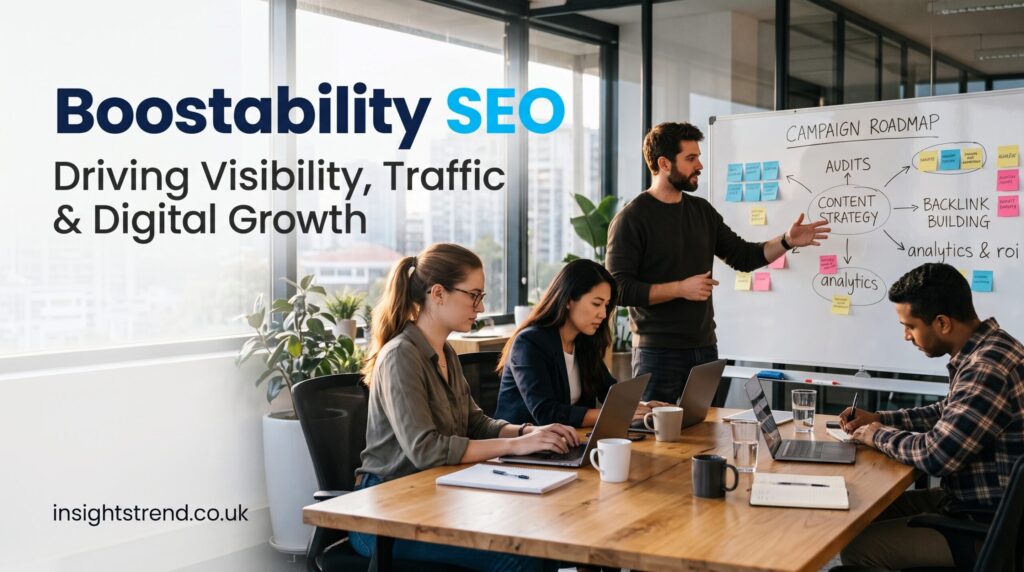
Based on how the company and third-party profiles describe it, the work follows a repeatable process: keyword research, on-page website optimization, business listing and citation cleanup, content creation, and link development. Local SEO, such as Google Business Profile updates and geo-targeted pages, is frequently described as a particular strength.
The standardized approach has an upside and a downside. The upside is predictable delivery at a lower cost. The downside is that templated work can miss what makes your business different. A dental practice and an online store need quite different strategies, and a fixed workflow may not fully reflect that.
The Be Found Framework and AI Search
In May 2026, Boostability announced an update to its Be Found Framework, its core methodology. The company says the update focuses on clean business data and authoritative content so that small businesses can appear in AI Overviews and voice search results.
Treat that as a statement of direction, not proof of results. Nobody outside Google fully controls inclusion in AI-generated answers. The sensible takeaway is that consistent business information and trustworthy content help, which is good practice regardless of provider.
What Does It Cost?
Pricing is where you should be most careful. An older Utah business-press article reported monthly customer spend ranging from $200 to $5,000. A separate third-party profile describes the core audience as businesses spending under about $800 a month on marketing. These figures come from different sources and dates, and they may not reflect current plans. I could not confirm a current public price list, so request a written quote that states the monthly fee, contract length, cancellation terms, and exactly what is included.
Results Claims: Read Them Carefully
The company states that 86% of its customers reach the first page of Google within six months, citing its keyword-tracking platform. That figure is self-reported, and I could not verify it independently. Several questions would help you judge it. Which keywords count? Are they branded or low-competition terms? Does “first page” include map results? A business name search is easy to rank for, while a competitive service term is not.
Look at independent reviews as well, keeping in mind that they are individual experiences. One reviewer on a business directory, for example, complained that a website duplication issue went unfixed and that the content was pushed to the following month. A single review proves nothing, but it shows the kind of delivery questions worth asking up front.
Benefits and Limitations
The case for Boostability SEO rests on affordability, a defined process, and a focus on small and local businesses, which many larger agencies avoid. If you have no in-house marketer, the managed approach removes a lot of work.
The limitations are the flip side. A standardized workflow offers less customization. White-label delivery can add distance between you and the people doing the work. And SEO takes months to show results, so a low monthly fee does not guarantee a return. No provider can honestly guarantee rankings.
Who It Is Likely to Suit
Boostability SEO appears best suited to local service businesses with modest budgets, such as restaurants, clinics, tradespeople, and regional shops, that want hands-off execution and have fairly standard needs. It also fits agencies that want to add SEO without hiring specialists.
It is a weaker fit for businesses in highly competitive national markets, companies that need custom technical work like complex migrations or international SEO, and owners who want close strategic involvement.
Questions to Ask Before You Sign
Ask who will write your content and whether a subject-matter reviewer checks it. Ask what link-building methods are used and how the sources are chosen, since low-quality links can hurt more than help. Ask for sample reports and for examples from businesses similar to yours. Confirm that you own your website, analytics, and Google Business Profile access at all times, and ask what happens to your content if you cancel.
Finally, set expectations in writing. Agree on which metrics matter, such as calls, form submissions, and map-pack visibility, rather than rankings alone.
Frequently Asked Questions
Is Boostability a legitimate company?
It has operated since 2009, has a corporate office in Lehi, Utah, and is covered by business media and directories. Legitimacy does not guarantee a good fit, so review contract terms and sample work before committing.
Does Boostability work directly with small businesses?
Yes, according to its own materials, but much of its business comes through partners that resell the service under their brand. Confirm which arrangement applies to you.
How long does SEO with Boostability take to show results?
The company cites six months for its first-page claim. As a general rule, SEO takes months, and timelines depend on competition, your site’s condition, and your market. Be skeptical of anyone promising faster guaranteed results.
How much does Boostability SEO cost?
Public figures vary by source and date, ranging from a few hundred dollars a month upward. Ask for a current written quote, because published numbers may be outdated.
Can I cancel if I’m unhappy?
This depends on your contract or your reseller’s terms. Ask about minimum commitments and cancellation notice before signing, and keep copies of every agreement.
The Bottom Line
Boostability SEO is a budget-conscious, process-driven option built mainly for small and local businesses and for agencies that resell services. Its strengths are affordability and structure, and its weaknesses are limited customization and reliance on a partner model. Use its own results claims as a starting point for questions, not as proof, and compare at least two other providers on deliverables, contract terms, and communication before you decide.
